Perception vs Reality
Why decisions begin with perception, not facts
← BackVisual Demonstration: The Checker Shadow Illusion
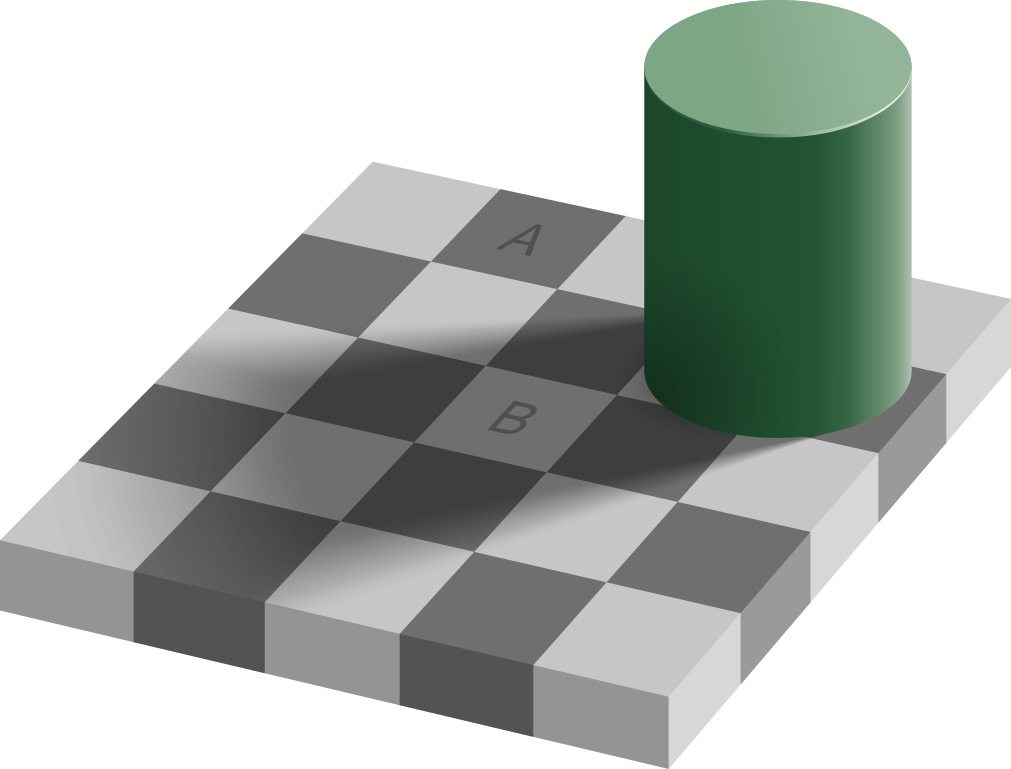
Squares A and B are identical shades of gray. Perception disagrees with measurable reality. The brain constructs what appears true based on context, lighting, and shadow—not on the actual physical properties of the squares themselves.
Image: Edward H. Adelson, MIT (1995) | Public Domain
How Humans Perceive Situations
Perception is not passive recording. It is active construction. The brain receives incomplete sensory data and fills gaps using prior experience, pattern recognition, and cognitive shortcuts.
This process happens faster than conscious awareness. Research demonstrates that the human brain can process visual images in as little as 13 milliseconds (Potter, Wyble, Hagmann, & McCourt, 2014). Neurons need to be active for only 20-30 milliseconds to mediate perception (Thorpe, Fize, & Marlot, 1996). However, there is an 80-100 millisecond processing delay between events in the real world and their internal representation in the brain (Johnson et al., 2023).
Three mechanisms drive perception construction.
Sensory Input Provides Raw Data
Vision, hearing, touch, and other senses deliver signals to the brain. These signals are filtered before reaching conscious awareness. The thalamic reticular nucleus (TRN) acts as a gatekeeper, selectively suppressing or allowing sensory information to pass to the cortex (Halassa, Chen, Wimmer, Brunetti, & Jazayeri, 2014). The prefrontal cortex signals the TRN to determine which sensory inputs to augment and which to suppress (Halassa & Kastner, 2017). This filtering occurs at the earliest stages of sensory processing, before information reaches higher-order brain regions (Fiebelkorn & Kastner, 2019).
Prior Experience Shapes Interpretation
The brain compares new sensory input against stored patterns from past encounters. When presented with ambiguous or degraded stimuli, neural activity patterns shift to match previously seen clear versions of those stimuli (He et al., 2018). This effect is more pronounced in higher-level brain regions than in early visual processing areas, suggesting that prior experience contributes more to perception than current sensory input in complex processing (Gonzalez-Garcia et al., 2018).
Psychologist Richard Gregory estimated that approximately 90% of information is lost between the time it takes sensory data to travel from the eye to the brain, requiring the brain to construct perception based on past experiences and stored information (Gregory, 1970). Pattern recognition relies on this comparison process, with the hippocampus enabling recognition based on past experiences and anticipation of future occurrences (Squire & Dede, 2015).
Cognitive Shortcuts Resolve Ambiguity
When sensory input is incomplete or unclear, the brain fills gaps rather than waiting for additional data. These mental shortcuts, termed heuristics, help humans quickly form judgments and make decisions in situations of uncertainty where information is incomplete (Tversky & Kahneman, 1974). The brain constructs coherent narratives from fragmented information by making inferences about reality and resolving ambiguities using prior knowledge and expectations (Friston, 2010).
Research on neural decision-making indicates that heuristic processing occurs when the brain is in a state of relative disengagement or "cognitive laziness," rather than active deliberation (Li, Ma, Rao, & Belger, 2017). These shortcuts allow rapid responses but create perceptions that feel complete even when foundational assumptions remain unverified.
The result is perceived reality—a constructed version of the world that feels accurate, immediate, and trustworthy. This perception guides behavior whether or not it corresponds to measurable external reality (Seth, 2013).
Perception operates as the foundation upon which all subsequent interpretation builds. Assumptions form on top of perceptual constructions. Biases filter what perceptions receive attention. Familiarity determines which perceptions feel trustworthy. Confidence solidifies perceptual interpretations into settled beliefs. The mechanisms documented in subsequent chapters all depend on this fundamental truth: human cognition begins not with reality but with a constructed perception of reality—and that construction occurs before conscious awareness can evaluate its accuracy.
Supporting Case Studies
The following documented cases provide real-world examples of perceptual construction mechanisms in operation:
- CS-001: The Endless Scroll Funnel — Demonstrates how visual presentation creates perceived legitimacy through length and professional appearance
- CS-002: The Assessment Questionnaire — Shows how question format creates perception of expertise and measurement validity